One of us lives on the east coast. One of us lives on the west.

One of us lives in a rural community. One of us lives in a city.

Both of us wander. Both of us witness. Both of us write.

This is a record of what we find.


Sunday, July 7, 2013

Summer


We forgot to say that we're taking off the month of July, to wander and dream and lie in the grass~or at least dream of wandering through the grass on a sunny summer afternoon...
We'll leave you with this and see you in August!

The Summer Day
Mary Oliver
Who made the world? 

Who made the swan, and the black bear? 

Who made the grasshopper? 

This grasshopper, I mean-

the one who has flung herself out of the grass,

the one who is eating sugar out of my hand,

who is moving her jaws back and forth instead of up and down-

who is gazing around with her enormous and complicated eyes.

Now she lifts her pale forearms and thoroughly washes her face.

Now she snaps her wings open, and floats away.

I don't know exactly what a prayer is.

I do know how to pay attention, how to fall down
into the grass, how to kneel down in the grass,

how to be idle and blessed, how to stroll through the fields,

which is what I have been doing all day.

Tell me, what else should I have done?

Doesn't everything die at last, and too soon?

Tell me, what is it you plan to do

with your one wild and precious life?

Thursday, June 27, 2013

The Landscape of Twelve


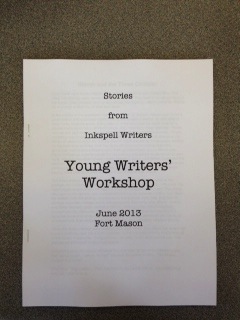
I spent last week at Fort Mason with my lovely writing, teaching, dog walking partner Ann Jacobus-Kordahl, mentoring twelve gifted writers.

We talked about developing characters—how they need to want something that’s hard to get—a desire with obstacles to struggle against. The twelve listened and thought and started to write.


We talked about struggle and conflict, tension and odds. You could see the ideas taking shape. They asked questions, thought some more and then wrote and wrote.

We talked about showing not telling—how dialogue and using the five senses help us to show. They got it and used it.

In the course of a week of afternoons, they created twelve amazing short stories. Two different and unique stories about lost mothers and daughters needing to find them.  A story of self-discovery and traveling the world, port to port. A story of an old man afraid to follow his dream until the right person gives him hope.  A story about a courageous thief who nearly gets away with the most valuable painting in the world. A story about a girl helping her family escape from Nazi occupied Norway. Another with an evil Martian despot who goes to war for a donut recipe. Another in a graveyard with the spirit of a dead author with the power to enter books who takes over the minds of three children. A story of a girl determined to help her softball team win the trophy. And another of a girl who must chose between her love of swimming and her politically radical parents. A story about a bullied girl who must summon the courage to fight for her beloved tree. And a story of four friends vacationing in London who band together to solve a murder mystery.


Really, really good stuff. Most of the writers were twelve years old. Two were eleven. One was thirteen. Their stories all had active characters with a strong desire or need, obstacles in their way, tension and conflict, sensual details, dialogue, and even endings that were surprising but inevitable. I'd somehow forgotten how smart kids are. I mean seriously—twelve years is not that long to be on this earth! How did they get so smart and creative and capable in such a short period of time?

We also ate a lot of popcorn. And talked about favorite books and favorite characters. And played some story/word games that made us all laugh so hard, we cried.

The one thing that was really hard for them was sharing their stories. Despite our encouragement, only four of the twelve were willing to read their stories to the group. When we realized that no amount of cajoling would change their minds, we told them we understood—that sharing is hard and makes us all feel vulnerable. We wanted to tell them that it gets easier. But we couldn’t lie.

It doesn’t get easier.  That part at least.

But life keeps getting better and better. Spending the week with these young writers made even more so.

Take Good Care,

Sharry

Thursday, June 20, 2013

The Landscape of Connection


I just finished A Tangle of Knots by Lisa Graff.


I really really liked it.  It's my kind of book, the kind with that particular magic realism...with a magic that is so cosy and comforting I wish it was real...and that, in fact, I sort of believe IS real.

The magic of connection.

Not the coincidence of connection, but the magic of it.  This is an important distinction, because I think many books utilize that coincidence device (a character runs into the exact person who has the exact piece of information he has been searching for) but fewer push that device into the realm of magic.  And I believe that the magic comes from...hmmmmm...this is where language fails me...this is not so easy to articulate...I believe it comes from the way two people can illuminate otherwise dark spaces within one another.  Think magic trick.  See the empty room. Presto!  There's a door.  See the door.  Presto!  There's a room behind the door that wasn't there before.  It's the feeling that someone has found something new for you, but there's also this feeling that it's been there all along...

Does that make sense?

A Tangle of Knots does this very well.  Across time and place and relationships.

Any other books you can think of that do this?

Anyone want to offer a different take on this kind of magic?  I would love to find a clearer way to define it...

Gratefully yours,
Tam

Thursday, June 13, 2013

Two Lives in Lettters


Last Friday  night my daughter Zoe and I went to see Dear Elizabeth—a play in letters from Elizabeth Bishop to Robert Lowell and back again—at the Berkeley Repertory Theater. The play depicts a lifetime of friendship in letters between the two poets, both brilliant and troubled, throughout the years between 1944 and 1977.  The playwright, Sarah Ruhl, had to work under the strict constraints given by the poets’ estates, to use their verbatim words and their words only to create the play, so she could add no invented dialogue to fill in the parts of the story that happened outside the letters. Instead, she did so beautifully, using stage magic and visual cues to paint a vivid picture of this extraordinary relationship.

The letters are at turns exuberant, witty, acerbic, affectionate, and compassionate. They take on each other’s work, each other’s lives, offering both praise and criticism, sympathy and advice. They share new work and give each other honest and at times, harsh feedback.

Elizabeth Bishop was a very private person; most of what the public knows about her is through her poems and letters. She moved throughout her lifetime; New York, Cambridge, Florida, Seattle, Europe, Brazil. She drank a lot and had a number of tumultuous relationships. In one of her letters in 1948 to Lowell, she told him, “When you write my epitaph, you must say that I was the loneliest person who ever lived. “

Robert Lowell was known for his brazen and evocative poetry, his clever quips, his heavy drinking, manic behavior and multiple marriages. Anne Sexton called him “gracefully insane.” He was arrested and hospitalized after holding his former mentor, poet Allen Tate, out a two story window in Chicago while reciting Tate’s poetry.

Both won Pulitzer Prizes; Bishop in 1956 for her second book, Poems: North & South—A Cold Spring and Lowell, three times, the last for The Dolphin in 1977 six months before he died.

As writers, we learn that the best way to reveal a character is through what they say and what they do. If you have any doubt, go see Dear Elizabeth or read Elizabeth Bishop’s and Robert Lowell’s poems and letters; the glimpses  you’ll get into the inner regions of their souls will make you a true believer.

Take Good Care,

Sharry

Here is a poem Elizabeth Bishop wrote for Robert Lowell:

The Armadillo
For Robert Lowell 

 
This is the time of year
when almost every night
the frail, illegal fire balloons appear. 

Climbing the mountain height,

rising toward a saint
still honored in these parts,
the paper chambers flush and fill with light
that comes and goes, like hearts.

Once up against the sky it's hard
to tell them from the stars—
planets, that is--the tinted ones:
Venus going down, or Mars,

or the pale green one. With a wind,
they flare and falter, wobble and toss;
but if it's still they steer between
the kite sticks of the Southern Cross,

receding, dwindling, solemnly
and steadily forsaking us,
or, in the downdraft from a peak,
suddenly turning dangerous.

Last night another big one fell.
It splattered like an egg of fire
against the cliff behind the house.
The flame ran down. We saw the pair

of owls who nest there flying up
and up, their whirling black-and-white
stained bright pink underneath, until
they shrieked up out of sight.

The ancient owls' nest must have burned.
Hastily, all alone,
a glistening armadillo left the scene,
rose-flecked, head down, tail down,

and then a baby rabbit jumped out,
short-eared, to our surprise.
So soft!--a handful of intangible ash
with fixed, ignited eyes.

Too pretty, dreamlike mimicry! O falling fire and piercing cry and panic,
and a weak mailed fist clenched ignorant against the sky!
Elizabeth Bishop