One of us lives on the east coast. One of us lives on the west.

One of us lives in a rural community. One of us lives in a city.

Both of us wander. Both of us witness. Both of us write.

This is a record of what we find.


Thursday, April 23, 2015

Interview with Megan Morrison and Kristin Brown about GROUNDED: THE ADVENTURES OF RAPUNZEL


We are THRILLED to have Megan Morrison, children's book writer; and Kristin Brown, geographer, here with us today. Megan's debut novel, GROUNDED: THE ADVENTURES OF RAPUNZEL, comes out April 28!


Tam: Hi Megan and Kristin!  Thank you for joining us here at Kissing The Earth. We are so excited to hear about Grounded, your reimagining of the Rapunzel story. A little bit about the novel, which is the first in a series: Rapunzel knows only her magical tower and her wonderful Witch, who guards her against evil princes far below. But when a peasant named Jack climbs into her life, Rapunzel learns that Witch is in terrible danger – and to keep her safe, she must leave her tower and journey with Jack on a quest far across Tyme. There she finds a world filled with even more peril than Witch promised…and more beauty, wonder, and adventure than she ever dreamed.

And with that, I'm eager to just dive right in to this interview!

GROUNDED is set in a fantasy world, but is its landscape based on any particular place in this world?

Megan: There’s a lot of North America in this landscape. Weather patterns tend to follow what one might expect in the United States, in particular. However, it’s a magical landscape, so when we want it to deviate from the real world, it can!

Perhaps the Limestone River?
Kristin: As I'd never tried to map a world created entirely by someone else before, it made the development a little easier for me if I tried to relate Tyme to places in our world. The Limestone River on the southern boundary of Orange meanders a bit like the lower Mississippi, and Yellow reminds me a lot of the American Breadbasket. Megan's description of the Lilac Lakes seemed very Scottish Highlands and so the lakes turned out quite loch-like on the map, and that large island off the coast of the Blue Kingdom is based on a tidal island I visited in Orkney. 

Tam: So very cool to see Tyme through your eyes, Kristin, and to be able to imagine those real places…you bring this fantasy world to life in this way.

Kristin: I also really like the idea of "plausible geography"—

Tam: What is that?

Scottish Highlands-like?
Kristin: —a realistic geographic explanation behind the magical landscapes. And Megan, who could have just have easily said "well, it's magic, so it just is" was totally up for this. So in places (many of which you won't learn about until later stories), where there's a—"magical barrier" might be the right term—I tried to think of places in our world that might be similar. For instance, the very high mountains to the north, in Pink—at the time I was working on the map, National Geographic had an article on the Hindu Kush mountains of Afghanistan, and how remote and difficult the terrain is. I mentioned this to Megan, and as it turns out, she'd also thought of Afghanistan as a possible comparison. So while Pink doesn't equal Afghanistan, the landscape is somewhat Afghanistan, but magnified. 

Tam: How did you both go about world-building for Grounded? Particularly, how did you build the landscape?

Megan: World-building has been a long, organic process of over a decade (and it isn’t finished yet). Politically and in terms of plot, I’ve built the world of Tyme with my friend Ruth Virkus, who is the co-creator of the series. Whenever I ran across a geography question, however, I called Kristin for help. Kristin is the sort of person who very thoughtfully answers any question that is put to her, so I always got more than I expected. I’d ask “Could there be a river here?” and she would send back rich, detailed answers and a list of accompanying questions that touched on things I’d never considered. Suddenly there were tributaries, bays, lakes… There are many places in Tyme that never would have been invented if Kristin hadn’t suggested them.

Tam: The best, most surprising stuff comes from collaborating!

Somewhere off in Pink?
Kristin: Yes, of everyone I know, Megan is, perhaps, the most willing to play the game of "what if?" She mentioned earlier that Tyme is a magical landscape, and it would have been very easy, as I mentioned earlier, for her to say "well, it's this way because it's magic and it just is and I don't care if it means this doesn't make geographic sense," but she was so willing to indulge every question. She and Ruth had already put so much thought into Tyme and its countries that I could ask questions like "Okay, if Blue is the fashion center of Tyme, where do they get the raw materials from and how do they transport them?" because that matters with regard to the landscape—and she either immediately knew the answer, or could confer with Ruth and have the answer within a day or two. While having this kind of knowledge made the mapping more complicated, it was also a lot of fun to discuss with Megan! 

Tam: It truly sounds like it was loads of fun! How exactly did you create the map for the world of Grounded, Kristin?

Kristin: The map evolved over a long period of time as a series of sketches. Once it was close to being what Megan and Ruth envisioned, I broke it down into layers (country boundaries, streams, cities, villages, etc) and put it into Illustrator—I'm a geographer by profession, and a GIS-approach seemed the most natural thing to do. This also made it easy to "hide" geography that Megan wasn't ready to reveal with the first book. 

The design side of the map was more challenging. Luckily, my painting mentor and friend, portrait artist Edward J Reed, also has a great interest in fantasy cartography, and he offered to sit down with me and discuss options. My goal was to provide a clean, workable map for the publisher to pass on to the book illustrator, and so I was hugely honored when they inquired about using my map directly. 

Cat Collaborator!
I should also credit my cat, who very helpfully crinkled the paper I used as a background texture.

Tam: Ha! Another collaborator! Okay, so can you talk a little about the landscape of Rapunzel's tower and her view from it?

Megan: Rapunzel lives in the deep south of Tyme, in the southern Redlands, on the border of Grey.

Tam: I have to interrupt and tell you that I love the color-names for so many things in Tyme, Megan. They are very evocative, of course, and just make me want to visit these places that I can see in this rainbow of hues—

Swamp-ish?!
Megan: Go a little further south, and you’ll vanish into the Impassable Swamps. The region is humid and forested, and the trees are exceptionally tall. Mostly, apart from the red dirt clearing that surrounds her tower, all Rapunzel can see is trees. At night, she can see the moon and the violet stars.

Kristin: A long time ago, I visited the Joyce Kilmer Memorial Forest in North Carolina—it's one of the only old-growth forests left in the US. You walk out into it, and you're surrounded by trees that are 100 feet tall, and just massive around. It's a very humbling place to be. The Redlands always makes me think of that.

Tam: Oh, see, so I can totally envision that! 

For me, in my own writing, I approach landscape almost as a character.  What do you think of that idea? And if you have any beliefs or thoughts around it, can you explain that a bit here?  Why is this so?  How do you manifest this belief in your work?

Megan: Before building Tyme, I’m not sure how I would have answered this question, but this landscape is definitely a character. It’s very much alive. Creating this world and all its features has been an enormous process, and every decision has been deliberate. I remember that when I first sat down to draft Grounded, I was daunted by the lack of ready landscape. Every time I wanted Rapunzel to go somewhere or do something, I had to stop writing, because as it turns out, it’s pretty much impossible to move a character around in a world that has no shape, no landmarks. Just like it’s hard to write a character who has no clear center of gravity, no quirks. These things take time, and lots of drafting.

Tam: True. Do you have a personal relationship to the landscape you created, Megan? 

Megan: It’s very personal. I can close my eyes and be in Tyme. The details are clear. There are so many beautiful places there. I wish I could physically visit them.   

What stories are here?
Tam: What do you think about the idea that landscape holds stories? The way a piece of land is, for instance, shaped over time (like where I live in Vermont, for example, morphed from sheep pasture to forest) and what that means for the people (characters) walking and breathing within it. Life happens over and over again on the same piece of land. Do those life stories get told?  Or are they felt?  So in the case of Grounded, does the landscape hold stories of Rapunzel's past?  Or of a time before her, even? Did you think of what had happened historically in each place you mapped?

Megan: Oh yes. I can’t answer this in detail, because mysteries would be revealed. But, for example, many wars have been fought in Tyme, and those scars linger. 

Kristin: Have you ever watched the BBC series, Time Team?

Tam: No—

And here?
Kristin: It's about a group of archaeologists and historians who visit sites all over the Great Britain and Northern Ireland, to tell the story of what happened in a place after just three days of investigation. They'll go somewhere where someone has found, say, medieval pottery in their back garden, only to find that it was also a place where Neolithic people lived, and the Normans, and cultures right up through today. Every generation seems to leave some sort of mark on the land.

Tam: I'm definitely going to watch it now. Wow. That's just what I'm talking about. Okay, Megan, what does landscape mean to Rapunzel?

Megan: At first, Rapunzel’s landscape is limited. Her only real, tangible landscape is her tower. As her landscape changes and expands, she changes and expands. Physical exploration and self-exploration are very connected for her.

Tam: Finally, I am curious about your take on the relationship between landscape and home. Do you think landscape helps create home?  Do you believe our inner landscape and our outer (environmental) one must be in synch? I ask this of all of my interviewees, and I know that it might be slightly off-kilter to ask about a fantasy world, but then again, maybe not…I really am so interested in this idea…what do you think?

Megan's old tossing grounds!
Megan: I was just reading an interview with Linda Ronstadt, and she said, “When you’re desert born, you love the desert.” She talked about feeling nervous when surrounded by too many trees. I’m the opposite: too much flat land makes me feel exposed. I live in the Pacific Northwest, in the Seattle area, which is cradled by mountain ranges. Tall trees and high peaks make me feel right with the world. So does the presence of water. I was raised in southern California and spent a lot of my childhood getting tossed around by the Pacific Ocean, so I’m most comfortable when my immediate environment includes access to big, shining bodies of water.

As far as Rapunzel is concerned, as she changes, she realizes things about the environment she grew up in. That happens to all of us, I think. We grow up, we look back, we question the “landscape” of our childhoods.

Tam: Oh yes!

Megan: It’s a natural process, but it’s painful. It’s bittersweet. I think back on the childhood bedroom I shared with my sister and there’s a part of me that would love to crawl back in there and hide from my adult responsibilities. But I wouldn’t fit there anymore, mentally or emotionally. That’s part of life: finding the landscapes where we fit, and moving on when the time comes.

Do you fit in this landscape?
Tam: And you, Kristin?

Or this one?
Kristin: I've spent a lot of time thinking about this myself. I left where I grew up in Western Kentucky to find a living in Northern Virginia. So many good life experiences have come about as a result of living here, but when I think “home”, I still think of Kentucky. Maybe that’s in some way a longing for my “childhood bedroom”, as Megan said, or maybe because it’s my nature to love places, it’s reasonable that I love my first place the best of all. But while I may always think of Kentucky as home, I have great affection for where I am now. I like horses and history, and Virginia is a haven for both, with rolling pastures, 18th century villages, and sunken dirt roads lined with trees and dry stone fences. It's the kind of place my horse-crazy, ten year old self used to imagine living. 

Or maybe this one?
Our geography helps to create what we think of as home, but it also has a tremendous impact upon our sense of well-being. The older I get, the more I realize how important it is to live and spend time within landscapes that are meaningful and inspiring. 

Tam: And that is a perfect way to leave off. It is important to spend time within landscapes that are meaningful and inspiring. Yes. And important to spend time inside books that are both meaningful and inspiring too!  I know Grounded is one of those.

Thank you, Megan and thank you Kristin, for taking the time to answer our questions. You have given us so much to think about.


Megan and Kristin: And thank you for the amazing questions, Tam! We had a great time working on this post together.


*          *          *          *          *          *          *


Megan Morrison is a mom, a middle-school teacher, and the author of GROUNDED: THE ADVENTURES OF RAPUNZEL (Arthur A. Levine Books/Scholastic). GROUNDED is the first book in the Tyme series, co-created with Ruth Virkus. Visit her at meganmorrison.net.

To order a copy of GROUNDED: THE ADVENTURES OF RAPUNZEL, visit Amazon, Barnes & Noble, or IndieBound. 


Kristin Brown is a geographer who lives in Virginia. Besides an interest in cartography (both professionally and personally), she also pursues painting and photography, often of places and horses. 

Thursday, April 16, 2015

Nizhoni Shima’—“My mother, it is beautiful!” (Revisited)


I'm off to Santa Fe again, so thought I'd repost this from a visit four years ago, along with the amazing ten minute video of Navajo weaver Clara Sherman carding and spinning wool for a rug she's going to make.

April 7, 2011

I just returned from a week in Santa Fe with my husband—our fifth visit to this place so radically different from where we live that we find ourselves drawn there time and time again.

The differences are obvious; the high (more than a mile high!) desert is a stark contrast to our watery, sea-level surroundings. Where the predominant colors in the Bay Area are shades of blue-grey (as in water, fog, air and cement) and green (as in trees), Santa Fe’s palette is made up of earth tones: browns and tans, terra cotta, adobe, pale sage and a lavender taupe that is the shadow of hills. Red and turquoise are decorative accents added to homes and personal accessories the way chilies are added to spice up the hearty fare.

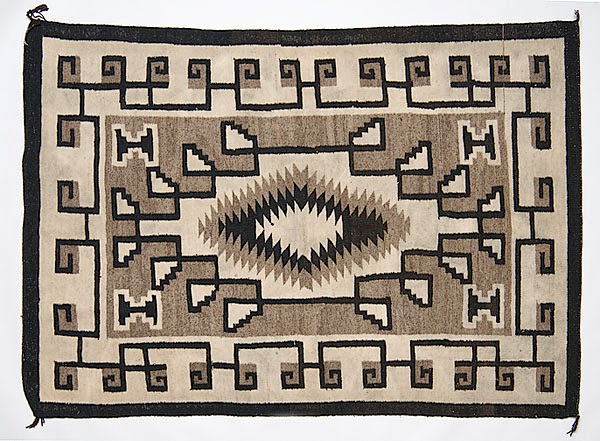
Over the years of visiting we have gained special appreciation for the native handcrafts, especially the beautiful woven rugs and tapestries that the Navajo women have been creating since the beginning of the 20th century. On our recent visit, we were very fortunate to catch the end of a display at the Wheelwright Museum of the American Indian; Master Weavers from the Toadlena/Two Grey Hills region. To even try to describe the exquisite intricately subtle artistry of the work shown could not do it justice. The show title best describes it; Nizhoni Shima’—“My mother, it is beautiful!”


If the video doesn't show up on your device, go to https://youtu.be/D_p7OIghMVw

Even more humbling is the understanding of the time dedicated to each piece; the shearing, cleaning, carding and spinning and washing alone can  take up to six months and then the weaving another 6 months to a year. For a better sense of the patience, dedication and attitude around the process, watch this wonderful 10 minute video of Master Weaver Clara Sherman. 

Many of the pieces have a thin line woven into the upper left hand corner that goes from the outer border to the interior of the weaving. We were told that it the spirit line—the path where Spider Woman enters the weaver and guides her through the process. A reminder for us all to leave space, leave a path that the universal creative spirit can enter to guide us in our work, whether it be weaving wool into stunning rugs or words into stories.


Take Good Care,

Sharry

Thursday, April 9, 2015

Repost: Landscape

This will be a simple post today. A poem of a post. One to remind me--to remind all of us, perhaps--to keep our hearts and eyes and ears open. But not only that, to also walk out the door in that wide, curious state-of-being. To make that a ritual. And in that way, to feel our wings, and our hearts, stretch from one end of the world to the other.

Hoping for Spring here in Vermont…ANY DAY NOW?!!!

Tam

Landscape by Mary Oliver

Isn't it plain the sheets of moss, except that
they have no tongues, could lecture
all day if they wanted about

spiritual patience? Isn't it clear
the black oaks along the path are standing
as though they were the most fragile of flowers?

Every morning I walk like this around
the pond, thinking: if the doors of my heart
ever close, I am as good as dead.

Every morning, so far, I'm alive. And now
the crows break off from the rest of the darkness
and burst up into the sky—as though

all night they had thought of what they would like
their lives to be, and imagined
their strong, thick wings.

Thursday, April 2, 2015

The Landscape of Welcome

I was out in the wilds of west Marin last week—we packed ourselves and our Sheltie Emma into the (new!) Mini and drove across the Golden Gate Bridge heading north to Inverness and Point Reyes. Yippee!

We forgot about traffic…ugh. There was a lot. I found myself wondering if we shouldn’t have just stayed home. I hate sitting in traffic—it’s boring and claustrophobic and bad for your mental and physical health. I entertained fantasies of abandoning our new car and walking home.


But we finally made it to our turnoff and were soon on a quiet country road with rolling hills of bright green on either side. We headed up the mountain, passing through dense and fragrant groves of redwood trees with a not-as-full-as-it-should-be river faintly chortling through the gully below and then back out to rolling hills with cows and wild turkeys and gnarly live oaks stretching their arms wide open as if to say ‘welcome to the country!’ We drove until we reached a fork in the road and pulled into a parking lot for a small county park with a trail that wandered next to a quite-full river that flowed out into Tomales Bay. 


As we followed Emma’s exuberant swish of a tail down the path, with the low afternoon sun stretching out the shadows of the newly budding branches of aspens and alders and river willows, a cool breeze off the river shushed through the leaves and tall grass. All around us choruses of robins and larks and finches filled in the high notes as they searched for their evening meal of gnats. I took a deep breath—the air smelled of damp earth and green bark and new buds and things that live in and around a river. Ahhhh—I felt the tensions of the city (and the traffic) fall away. Standing still, listening, feeling the wind and the sun and the soft earth beneath my feet, I had the profound and greatly relieved sense of belonging in the world.


Sometimes, you just got to get out of town.

The night before, I had gone with my dear friend Ann to hear Anne Lamott—charming, hilarious and wise as ever—speak about grace and read from her newest book, another little gem of life lessons called Small Victories, Spotting Improbable Moments Of Grace. The first chapter, titled The Book Of Welcome, talks about the need for all of us to find a place where we feel welcome in the world and how community does that for you. She says that in her thirties…she got sober, because she’d gone crazy. Then:

A few women in the community reached out to me. They recognized me as a frightened lush. I told them about my most vile behavior and they said, “Me too!” I told them about my crimes against the innocent, especially me. They said, “Ditto. Yah. Welcome.” I couldn’t seem to get them to reject me. It was a nightmare, and then my salvation.

“It turns out that welcome is solidarity. We’re glad you’re here, and we’re with you. This whole project called you being alive, you finding joy? Well, we’re in on that.

I couldn’t agree more…

But I’ve personally also found that some of the places I feel most welcome on earth are in nature, especially those places where the elements of earth, water, fire and air are all boldly present. Standing at the edge of a lake as the sun sinks below the far hills; walking barefoot at the edge of the ocean at low tide as the water rushes in and out, shocking my feet awake; sitting in a meadow of wild grass and mountain iris watching a stream wind its way over stones. Perhaps these moments of grace touch me deeply with a sense of being one with the world because they are undemanding and non-judgmental and all that’s required of the moment is to be present.


And yet, as we drove back into San Francisco in the early evening and the lights were just starting to go on in our jewel box of a city, I also had a joyful feeling of gratitude and homecoming. I do love where I live and feel so lucky to be able to get in the car and drive for twenty minutes and be surrounded by nature. Even if you do have to put up with a little traffic now and then.

Where do you feel welcome in the world?

Take care,


Sharry


Friday, March 27, 2015

Reprise: The Landscape In Between

I kinda feel this way again, everyone.  Is it the time of year?  Maybe…


*     *     *     *     

I am in that straddling place.

That place that is one part rocky and one part sand. One part windy and one part heat. The place that is the water between two islands, that long stretch when you can't see land but you know it is behind you and you know it is in front of you and so you contemplate your options, tread water or swim, baby, swim...

I choose to swim, but I am tired. Man, am I tired.

It's an age old place, and an age old murmur in the brain. I know that the straddling place should have its own name. It shouldn't be nameless, those that are nameless don't turn their heads to familiar voices because no one calls to them, no one can call to them. And so they grow more and more aloof, and protective. They grow vines with thorns.

I also know that, truly, the straddling place does have many names. My friend, Kara, who teaches yoga calls it being in the moment. And my son, Luc, who is a cross country runner, calls it the zone.  There are other names too: the process, patience and faith.  Even I have given it names before. My favorite is it is what it is. Kind of catchy, right? Chameleon-like. When I call it that I feel bold and brave. I feel like an explorer who is in it simply for the rocks and the sand and the wind and the sun.

But that name escapes my brain now, and I can't find my compass or my map, and I forgot to bring enough water and nuts. I'm tired. I'm hungry. And I feel like I'm on uneven ground.

Oh my gosh. Pathetic.  I don't mean to be pathetic. I mean to be honest and I mean to put these three questions out to you all:

What do you call this place? What is its landscape?  And how do you find a sense of home here?


*    *    *    *    *    *

Last night I sat on the couch and finished a book. A great book.  One that inspired me as a person and as a writer. The pellet stove was chugging. The room was warm. I had a glass of seltzer on the window sill behind me with just the right amount of fizz because yesterday was pay-day and I went to the store to finally buy a new CO2 canister. The chickens were tucked into their coop, but my middle daughter, Zory, tread down the stairs, too late for her to be awake.

You should be in bed I said.

I can't sleep she said.  She looked at the book face down on my lap.  What book is that?

A really good one I said. Actually I read it to see if you might like it. And I think you will.

She stretched out her hand. I put the book carefully in it. She read a page. She looked at the cover. Is this Maureen or Debbie?* she asked, pointing to the girl riding over a bridge on her bike.

Debbie I said. You need to go to bed. You have school tomorrow. 

But I can't sleep. Don't you ever feel that way?

For some reason the question brought tears to my eyes. I nodded my head in agreement.

So can I read a little more? she asked. Just until the end of the chapter. Please?  I like the book so far.

I nodded again.

Zory leaned back on the other side of the couch. Her knees were bent and the book rested on her thighs. I looked out the window. It was black outside. I felt the glass on the window. And cold. It was cold out there too. The last remnants of winter skulking around in the night. I looked back at Zory. Her brow was furrowed. Her mouth was slightly open. She was unaware of me in that ten-year-old way that she usually was. When had it happened? When had she become the kind of reader that walked inside a book and sat down with girls like Maureen and Debbie and didn't walk out until she was done?  When had she become the kind of reader that I had dreamed I would give birth to, who would sit on the couch with me, warmed by the stove and warmed by the words?

Twice in one night Zory brought tears to my eyes.

I thought about the Zory of before, I thought about where she was going.  And, last night, I felt like I could sit on that couch forever in that place in between, in that straddling place. In that place I call home.

*    *    *    *    *    *

It is what it is.  The zone.  Being in the moment.  The process, patience and faith.

What do you call this place? What is its landscape?  And how do you find a sense of home here?

Gratefully yours,

Tam


*Can you guess what book Zory was reading??

Thursday, March 19, 2015

The Rich Landscape Of Travel


I was recently in Mexico—Mexico City, San Miguel De Allende and a day in Guanajuato. The time spent there was sensual, mind-expanding and so rich in images and experience.

Travel has always been important in our family, a priority that trumps most all other discretionary spending and hits the top of the list when we’re budgeting time and resources.

People often ask me, but what do you do when you travel?


Well, we do what we most like to do when we’re home, but more of it. We wander, we consider the landscape, we look at architecture, visit galleries and art museums, listen to music, hang out at side-walk cafés, talk to the dogs, eat locally and drink the local wine. And we always stop in a pharmacy and buy a tube of toothpaste.

I keep a journal. This past trip, I kept two. One to share and one just for me where I jotted down images and experiences and notes for a poem or short story, plus 4 rough-hewn sketches that helped me “see” more detail in an image I’d noted. (A practice I’ve now incorporated into my everyday journaling. Thank you, Lynda Barry!)


I thought I’d share one day from our trip (from the to-share journal):


Wednesday February 25, San Miguel de Allende
 
Breakfast in the lovely courtyard of our hotel.

Then we took a taxi from San Miguel to Guanajuato in a car with no seat belts. Our drivers name was Juan Jose—he spoke no English and had a silver cross on a string of green rosary beads dangling from the rear view mirror. He picked up a friend and then took us to see the mummy museum displaying the people who have been dug up from the cemetery to make room for more people, explaining in Spanish that only the very wealthy stay buried.


Then they took us to a church on top of a mine and showed us the gloppy gilded altars and sent us with a guide, deep, deep, down many flights of steep slippery stairs into the mineshaft. The guide insisted we keep taking pictures of each other posed as miners. Then we drove through the tunnels left over from the old mines into the center of town where we had a nice outdoor lunch on the square; shrimp tacos on a big spinach leaf and a paper thin slice of jicama and then soup. We walked around town holding hands and soaking up the spectrum of heat-soaked colors, then drove back to San Miguel and looked at the cactus and yellow flowers of Saint Mary and the dry hills of the Sierras de Guanajuato. Back in San Miguel, we chilled a little then went back out to see a few more galleries on Bob's recommended list, had some ice cream at Santa Clara creamery, a drink on the roof of Mama Mia.


On our way to find the restaurant where we wanted to eat, we saw a parade come up a quiet dimly-lit narrow street with a motorcycle policeman escort; a decorated donkey, two huge puppets—a lady and a Mexican wrestler with a horn band—maybe for lent? Also a group of tourists riding horses. We had a lovely light dinner at a new modern restaurant, Cumpanio, that had a repeating video of silhouetted white dog images playing on a wall in the bar.

I'd love to hear where you've been and what you've seen...

Take Good Care,

Sharry

Thursday, March 12, 2015

The Landscape of Longing Repost

There is a space between man's imagination and man's attainment that may only be traversed by his longing.
                       
                                                                                               ― Kahlil Gibran from Sand and Foam 


I am thinking about longing this week.  I think about it often, and I know I have written about it here before.  It's a complicated thing, longing.  It's a good thing, a great thing, a salvation. To long for something is an affirmation of your very self; a vibrant reminder that you care and you feel and you have a bonfire burning inside. But it is also an ache, isn't it?  A pull outside of yourself – for what you desire is not with you, not yet.  It is your head against the cold of the windowpane, searching, searching through the glass for that thing, that (as of yet) unattainable thing.

I tend to rest, ultimately, not on the dark side of longing, but on the light side.


God speaks to each of us as he makes us, then walks with us silently out of the night.
These are the words we dimly hear:
You, sent out beyond your recall, go to the limits of your longing. Embody me.
Flare up like a flame and make big shadows I can move in.
Let everything happen to you: beauty and terror. Just keep going. No feeling is final.
Don't let yourself lose me.
Nearby is the country they call life. You will know it by its seriousness.
Give me your hand.
                                                                        — Rainer Maria Rilke, Go to the Limits of Your Longing


I had an epiphany this week though.  Perhaps you all already know this, but for me it was an eye opener.  I realized that, historically, when I feel a longing, I immediately and unconsciously attach it to many, many thoughts or memories or fantasies. Let me explain: I long for something. Nanoseconds later I either have a fantasy about that longing – What would it be like to have this? I can see myself having it, feeling so happy, sitting in my living room basking in its glow… or I have a memory about it – I remember when I wanted this before. I almost had it, and then, in the last moment, it fell through my fingers. It felt awful, I felt like a failure…

See?  In the former, my longing is hitched to a fantasy train, wildly careening down the tracks, and in the latter, it is strapped to a memory bomb, whistling and hurtling at terrifying speeds to the earth.  Both are a ride. Neither will get me anywhere useful.

So my epiphany was this idea that longing is best treated with a buffer of space and reverence. It needs to breathe.  It needs to be – not lonely, perhaps – but solitary.  It deserves to be respected in that way.  We who feel longing deserve to be respected in that way.

I know I have posted this poem before, but May Sarton says it in the very best way:


The phoebe sits on her nest

Hour after hour,

Day after day,

Waiting for life to burst out

From under her warmth.


Can I weave a nest of silence,

Weave it of listening, listening, listening,

Layer upon layer?

But one must first become small,

Nothing but a presence,

Attentive as a nesting bird,

Proffering no slightest wish

Toward anything
that might happen or be given,

Only the warm, faithful waiting,
contained in one’s smallness.


Beyond the question, 
the silence.

Before the answer, 
the silence.


— May Sarton, Can I Weave a Nest of Silence

With gratitude,
Tam