One of us lives on the east coast. One of us lives on the west.

One of us lives in a rural community. One of us lives in a city.

Both of us wander. Both of us witness. Both of us write.

This is a record of what we find.


Showing posts with label Santa Fe. Show all posts

Thursday, April 16, 2015

Nizhoni Shima’—“My mother, it is beautiful!” (Revisited)


I'm off to Santa Fe again, so thought I'd repost this from a visit four years ago, along with the amazing ten minute video of Navajo weaver Clara Sherman carding and spinning wool for a rug she's going to make.

April 7, 2011

I just returned from a week in Santa Fe with my husband—our fifth visit to this place so radically different from where we live that we find ourselves drawn there time and time again.

The differences are obvious; the high (more than a mile high!) desert is a stark contrast to our watery, sea-level surroundings. Where the predominant colors in the Bay Area are shades of blue-grey (as in water, fog, air and cement) and green (as in trees), Santa Fe’s palette is made up of earth tones: browns and tans, terra cotta, adobe, pale sage and a lavender taupe that is the shadow of hills. Red and turquoise are decorative accents added to homes and personal accessories the way chilies are added to spice up the hearty fare.

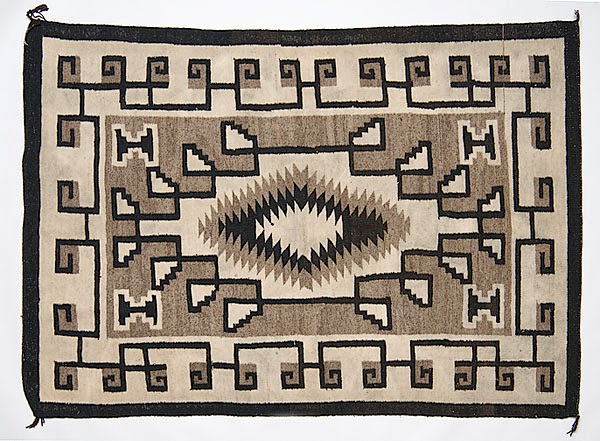
Over the years of visiting we have gained special appreciation for the native handcrafts, especially the beautiful woven rugs and tapestries that the Navajo women have been creating since the beginning of the 20th century. On our recent visit, we were very fortunate to catch the end of a display at the Wheelwright Museum of the American Indian; Master Weavers from the Toadlena/Two Grey Hills region. To even try to describe the exquisite intricately subtle artistry of the work shown could not do it justice. The show title best describes it; Nizhoni Shima’—“My mother, it is beautiful!”


If the video doesn't show up on your device, go to https://youtu.be/D_p7OIghMVw

Even more humbling is the understanding of the time dedicated to each piece; the shearing, cleaning, carding and spinning and washing alone can  take up to six months and then the weaving another 6 months to a year. For a better sense of the patience, dedication and attitude around the process, watch this wonderful 10 minute video of Master Weaver Clara Sherman. 

Many of the pieces have a thin line woven into the upper left hand corner that goes from the outer border to the interior of the weaving. We were told that it the spirit line—the path where Spider Woman enters the weaver and guides her through the process. A reminder for us all to leave space, leave a path that the universal creative spirit can enter to guide us in our work, whether it be weaving wool into stunning rugs or words into stories.

Take Good Care,

Sharry

Thursday, March 28, 2013

The Landscape of Transformation


I was in Santa Fe, New Mexico last week taking in the clean, dry air, the warmth of the high desert sun, the scent of pinion smoke, sage brush and scrub pine. We admired the beautiful richly hand-woven rugs with their subtle earth tones and indulged ourselves with the wonderfully spicy taste of chilies.


Besides revisiting many favorite haunts, we also discovered a few new ones. One of the highlights of the trip was a visit to Seton Village and The Academy For The Love Of Learning.

Located outside of Santa Fe on 86 acres of high desert, Seton Village was the home of the late Ernest Thompson Seton, (1860-1946) naturalist, artist, author and pioneer of ecology and environmentalism. My husband keenly recalls receiving a copy of Seton’s Wild Animals I Have Known as a child and finding the naturalist’s stories about wild animals and the underlying activist message of conservation and wildlife preservation life changing.


Ernest Thompson Seton’s own story is one of transformation. Artistically gifted, he studied art in Paris and London in the late 1800’s and became an accomplished wildlife painter before he was 20.


But he originally made his living as a wolf tracker and killer. Until a trip to New Mexico in 1893. He’d come to kill fifteen wolves, but his experience with the landscape, with observing the natural habitat and the animals that inhabited it and his interactions with Blanca and Lobo, two wolves he hunted, changed something deep inside of him. Witnessing the overwhelming grief that Lobo displayed when he discovered the spot where his mate, Blanca, had been killed, transformed Seton, converting him to the conviction that animals are related to humans in a moral sense, making us responsible for their preservation. The popularization of this contemporary belief can be traced back to Seton more than anyone else.


After his experience with Lobo, Seton reinvented himself from hunter to champion of wildlife for the remainder of his life, writing and illustrating over sixty-five books about animals and nature, and starting Woodcrafters—a youth organization that gave young people the opportunity to participate in native American crafts and personally experience the natural landscape. It also greatly influenced Baden-Powell and the formation of The Boy Scouts of America.


It is well fitting that The Academy For The Love Of Learning, founded in 1998 by composer Leonard Bernstein, chose what remained of the once 2500 acres of Seton Village as their home. They felt that Seton’s own transformation proved the human capacity to grow, change and embrace “life-affirming values and justice.” One of their many projects is The Learning Landscape, which “seeks to draw out the natural impulses of this land, just as our transformative learning model draws out people’s inner voices and gifts.” For more information about this inspiring organization, check out their website: www.aloveoflearning.org

To bring this around to my own writing, I have been thinking a lot about character transformation and the kinds of experiences and epiphanies that can bring about this extreme transformation. I believe that Ernest Thompson Seton is a great role model for character development!

I’ll leave you with a short video that shows another transformative project at The Academy For The Love of Learning—their LifeSongs project.


Take Good Care,

Sharry

Thursday, April 7, 2011

Nizhoni Shima’—“My mother, it is beautiful!”

I just returned from a week in Santa Fe with my husband—our fifth visit to this place so radically different from where we live that we find ourselves drawn there time and time again.

The differences are obvious; the high (more than a mile high!) desert is a stark contrast to our watery, sea-level surroundings. Where the predominant colors in the Bay Area are shades of blue-grey (as in water, fog, air and cement) and green (as in trees), Santa Fe’s palette is made up of earth tones: browns and tans, terra cotta, adobe, pale sage and a lavender taupe that is the shadow of hills. Red and turquoise are decorative accents added to homes and personal accessories the way chilies are added to spice up the hearty fare.

Over the years of visiting we have gained special appreciation for the native handcrafts, especially the beautiful woven rugs and tapestries that the Navajo women have been creating since the beginning of the 20th century. On our recent visit, we were very fortunate to catch the end of a display at the Wheelwright Museum of the American Indian; Master Weavers from the Toadlena/Two Grey Hills region. To even try to describe the exquisite intricately subtle artistry of the work shown could not do it justice. The show title best describes it; Nizhoni Shima’—“My mother, it is beautiful!”
 
Even more humbling is the understanding of the time dedicated to each piece; the shearing, cleaning, carding and spinning and washing alone can  take up to six months and then the weaving another 6 months to a year. For a better sense of the patience, dedication and attitude around the process, watch this wonderful 10 minute video of Master Weaver Clara Sherman. 

Many of the pieces have a thin line woven into the upper left hand corner that goes from the outer border to the interior of the weaving. We were told that it the spirit line—the path where Spider Woman enters the weaver and guides her through the process. A reminder for us all to leave space, leave a path that the universal creative spirit can enter to guide us in our work, whether it be weaving wool into stunning rugs or words into stories.

Sharry