One of us lives on the east coast. One of us lives on the west.

One of us lives in a rural community. One of us lives in a city.

Both of us wander. Both of us witness. Both of us write.

This is a record of what we find.


Thursday, May 30, 2013

The Landscape of Recology


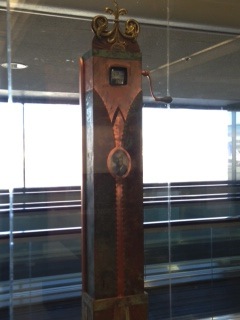
Traveling is always edifying and often begins at the airport. On our way from San Francisco to New York to attend our beautiful daughter Zoe's graduation from Sarah Lawrence last week, we pulled our roller bags through SFO Museum’s Terminal Three gallery, stopping every few steps to smile, ponder and be delighted by the whimsical and thought-provoking pieces created by The Art Of Recology’s Artists in Residence program at San Francisco’s Recology Center between 1990 and 2013.

It all began with artist and activist Jo Hanson (1918--2007) when she moved to the Haight Ashbury in 2007. Her artist's statement says it all:

“All of my work takes shape with love and care and takes issue with waste and disregard. I feel the work as a metaphor for transformation and transcendence. It insists that we change our ways and our thinking and become guardians of the resources of the earth which supports our life and is more fragile and endangered than we used to believe possible.”
You can read more about Jo and the program at: SFO Museum The Art of Recology


Here is a small sampling of some of my favorite pieces from the show:

 Remi Rubel


Nemo Gould


Daphne Ruff, Sarah Barness and Hector Dionicio Mendoza

                                                                   Linda Raynsford


Looking at Gaza Bowen's books made of recycled, corroded metal, I couldn’t help but think about the idea that there are no new stories, just endless variations on the old ones and how even Shakespeare took the words of writers and dramatists before him to use in his own plays. We all borrow and steal our ideas from the wealth of material that has come before us. Perhaps we too are recyclers? If so, we’re certainly in good company.

Take Good Care,

Sharry


Thursday, May 23, 2013

The Landscape of a Car Trip

I know what bleary-eyed means. Oh yes.  I know we all do, and we all probably have for a long time.

Think long hours up at night with a crying baby.
Think long nights studying for a mid-term.
Think long conversations that brought the sunrise.

For the last two days, though, my eyes have been--well--bleary. And I am experiencing that very visceral, terribly twilight zone-y kind of feeling. I got up at 3AM yesterday morning and drove, with my friend Kara, twelve hours to Michigan for the Odyssey of the Mind World Finals competition that my son Luc's and Kara's daughter Claudia's team is competing at.  It's pretty crazy here.  Thousands of kids from all over the United States, as well as from Hong Kong, South Korea, Japan, China, Poland, Russia, Switzerland, Canada, and Germany. Pretty crazy and pretty cool.

But I was talking about bleary eyes.  And a long car ride.  And the way traveling for hours upon hours on the highway makes you feel like you have popped through the wardrobe, or down the rabbit hole, or  into the forest.

Time elongates. Every minute counts. (And you count every minute.)  Yesterday felt like five days.

About three hours into the trip we ended up behind a truck. A truck filled with crates.  Crates filled with chickens.  And one chicken had escaped and was sitting on top of the truck.


No, I don't mean like this.


Chicken Truck by Krystal Allen


                  I mean more like this.


Except the truck was on a highway, going 60 miles an hour, and the chicken was white, hanging on for her dear life.

It was an incredible sight.
It was an incredible metaphor.
And it was incredibly funny.

Luc and Claudia made up a song about it, it was so funny.

Chicken on a truck
Chicken on a truck
Ch-ch-ch-ch chicken on a truck...

Pretty hilarious when you sing this into I-pod app that adds dance music, mixes, and plays back your fully accompanied song. Pretty hilarious when you have been up since 3AM and went down the rabbit hole.

Chicken on a truck.  It's my new anthem.  And it's my go-to reminder of middle grade humor.


With gratitude,
Tam


Thursday, May 16, 2013

The Landscape of Elision


I spent this Mother’s Day weekend in Seattle with my lovely daughter, Ceinwen. We flew up to visit my mom and to see a show at the Francine Seders Gallery—a stunning series of drawings by my dear artist friend, Fred Birchman. (Please check out his show at http://www.sedersgallery.com) We also spent some time exploring Seattle.

One of the standards I use to measure an urban landscape by is the amount of public art—to me it says so much about the soul of a city. Seattle has a lot. Especially impressive is SAM’s (Seattle Art Museum’s) Olympic Sculpture Park, an open and living green, nine-acre transformed industrial site on the Seattle waterfront overlooking the Olympic Mountains and the Puget Sound.


It was a gorgeous, warm, sunny afternoon as we wandered through the sculpted space of this urban park. We strolled past Mark di Suvero’s Bunyon’s Chess—wood pilings suspended between steel to interact with the wind.


We peeked over the wall at Claes Oldenburg’s Typewriter Eraser—a humorous piece inspired by an object antiquated to anyone under forty.


We moved through, moved around, undulated between Richard Serra’s Wake, a landscape of steel forms reminiscent of both waves and of ships’ hulls; it’s the viewer’s own movement that gives the mammoth sculpture motion.


We stopped and gazed at Alexander Calder’s The Eagle, 6 tons of painted steel, and talked about how the negative space—the shapes of sky and grass and buildings seen between the limbs of orange steel, are just as important, just as evocative as the sculpture itself and how the positive actually sculpts the negative space around it.


Which got me thinking about negative space. Sculptors, painters, printmakers, draftsmen, (draftspersons?), even dancers, understand the vital importance of negative space. We writers don’t always think of it in those terms, but I think it is essential to remember that what isn’t there can be just as important as what is there. Think about dialogue and how tension is created by what is not said. (It’s a good tool to keep handy in your writer’s tool box!)

But beyond technique, we need to leave space for readers to move through, room for readers to make a story their own. Too many details can take up this space and actually deprive the reader the pleasure of filling in what has meaning for them. Elision in a piece of writing is the shared space between writer and reader, where the reader brings his or her own experience to the page.

Another way to think about it: whether we paint, sculpt, dance, write or sing, the space between the form is where we breathe. So take a deep breath...

Take Good Care,

Sharry

Thursday, May 9, 2013

The Landscape of the Bed of Longing


I feel on-my-knees grateful for the people in my life. I don't know how to articulate the depth of that gratitude... I mean, I can barely scratch the surface of the meaning my family, friends and community make of my life. I feel the same way about my home, the landscape around my home, the dogs, cats and chickens in and out of my home. And I most definitely feel the same way about being a writer.

by Thiemo Muller
 But--or maybe And is a more appropriate conjunction--And, at the same time, this sense of longing has taken up residence inside me...somewhere near my heart, lodged against the curve in my ribs. I feel it in my heartbeat, I feel it when I breathe. I know the reasons for it. There are a few. For now, and for here, I will say that some of it is about wanting to sell a book, wanting to work with an editor, wanting to feel that collaboration and build a story in that way, and wanting to finally see my book in print and share it share it share it with the world.

My longing for this experience is intense. So intense that sometimes, for short bursts of time, it blocks my view, and blocks my other sensory capacities, of other details in my life. Do you know what I mean?


I've been contemplating this longing for the last few weeks.  I have noticed that there is a tendency to do one of two things with longing.  One is to try to push it away. And I think the most common way to accomplish that is to transform it...so maybe, let's say, you turn it into jealousy (she got that and I was supposed to get that and I'm probably entitled to that more than she is, damn it...) or into denial (I never wanted that, and even if I did, which I didn't by the way, but even if I did, I certainly don't want it now...) The other is to allow it to consume you (I feel this longing so badly and so deeply that I think I, in fact, AM this longing...where are my hands and feet and heart and mind?...they have been taken over by the body-snatching longing monster...)

But what about just letting it...be?

When my sister, Callie*, was diagnosed with cancer she had, not surprisingly, a deep and loud fear. I remember sitting by her bedside during a few of her chemotherapy sessions and listening to her talk about it. She told me she knew she couldn't push her fear away. She told me she knew, also, that she couldn't let it become her either. And so, she said, she was learning to sit with it...pull up a chair, invite that ole' deep and loud fear to sit, not on her but next to her.

A chair for her fear.

I mentioned this idea to two of my friends** while I was contemplating my longing one morning (and by contemplating it I mean, on this particular day, having a total crying breakdown about it...sigh...what can you do?!) and one of them said, You need a bed for your longing...a place to tuck it in, let it be, while you get on with being you... The other one came over later that day and gave me this:


An actual bed for my longing! Isn't it awesome?  A beautiful purple bed with cozy white feathers to rest upon...

So here's the other part of my contemplations: longing is not a bad thing. It might not be the most comfortable feeling in the world (think a slightly-too-sharp object stuck under your rib), but if it is given a place to call home, longing kind of smooths itself out, and is even kind of sweet-looking as it rests there... Longing is not a bad thing at all.  It lets us know what matters in our lives. It indicates our dreams. It reminds us that we have hearts and minds and that they are beating and buzzing all the time.

The trick, for me, is to let longing hang out while I sit at my computer revising my picture book for the 12th time, or writing a new chapter for my middle-grade novel, or or or...

And now that it has its own happy home, I can do just that.

One more contemplation: It feels good to talk about longing. I have a hunch that if we writers, especially, talked about it more we would feel better.  Pure longing, no more, no less. What a cool topic for an SCBWI conference, perhaps?  Or for a conversation between blogs? My amazing friend Sarah posted this today...so worth the read...

What do you all think?

With gratitude,
Tam


*Callie, by the way, kicked cancer's butt, as she likes to say. I think it's been four years now that she has been cancer free...talk about on-my-knees gratitude...

**Thank you Alice and Stef...

Thursday, April 25, 2013

Light as Sculpture


There’s something happening out on the San Francisco Bay—a landscape of mesmerizing, rippling LED lights that cover 300 vertical cables on the western span of the San Francisco Bay Bridge between the Embarcadero and Yerba Buena Island.


I can see it from several vantage points near my house, including my roof and back porch window. Each time I catch a glimpse, I’m thrilled. It’s dazzeling, magical the way it dances across the water.


Designed by renowned artist Leo Villaral as a public arts project, The Bay Lights is a light sculpture inspired by the Bay Bridge’s 75th anniversary. It opened on March 5th and will continue for two years (or hopefully longer the funding can be raised) It consists of 25,000 white LED lights each computer programed by Villaral to create a never repeating pattern of light from dusk to dawn. It covers 1.8 miles and leaps up the cables 500 feet. It’s the largest light sculpture in the world.


Light is a wonderful medium. I’m a devotee of another San Francisco based artist, Jim Campbell, and his numerous light sculpture installations. His Exploded Views brought me back to SFMOMA again and again to be enchanted by the chandelier-like sculpture that hung over the front doors with the ever changing shadow figures fleeting across the ethereal matrix, with four different programs; a collaboration with Alonzo King’s LINES Ballet, a flock of birds, the candid movements of San Francisco pedestrians and a choreographed boxing match


Last week, I had the privilege of seeing Miwa Matreyek present a work in progress and then her spell binding Myth And Infrastructure in an outdoor performance at the new gorgeous Exploratorium at Pier 15. (more on that next time!) Miwa uses light, video, animation and performance to create a stunning vision, where the line between what is real and what is fantasy/illusion blurs, creating a world of its own that viewers fall into. The experience is part cinema, part live theater, with light as the medium of magic.


As we left the Exploratorium around 10:30 at night, we were treated to a spectacular lazer light show, projected onto the front of the Pier.  


Light can also be a transportive element in writing—it can play many roles from simple atmosphere to the objective correlative, showing character emotion—how the character perceives his or her surroundings or what the character choses to focus on can speak volumes about their emotional landscape.

It was well over a century ago that Nathaniel Hawthorne said, “Moonlight is sculpture”

And then there’s this: “In the beginning there was nothing.  God said, "Let there be light!"  And there was light.  There was still nothing, but you could see it a whole lot better.”  Thank you, Ellen DeGeneres!

Here are links to videos showing some work by the artists mentioned above:


Myth And Infrastructure: http://vimeo.com/10278043

Take Good Care,

Sharry

Thursday, April 18, 2013

The Landscape of Good-Bye

My running buddy, Cody, is gone. He was Kara's dog and we all ran together, with my dog Winn-Dixie, three times a week. On the river trail. At Mud Pond. In the cornfield at the end of our road. We've done it---consistently, religiously, rhythmically---for the last few years or so.

Kara is always the leader. She sets the pace.
Cody is always second in command. His steady gait focuses me, and on dark, winter mornings the white tip of his tail is like a light.
I take up the rear.
(And Winn-Dixie? He runs here and there, and way over there, and then comes on back and does it all again.)

It is this way.
It was this way.
But Cody died.
And so the landscape of my runs has changed.


Cody was this enormous black and white dog. Part border collie and (if you asked Adam, Kara's husband, he would say:) part holstein cow. Smart and sharp, he would stare into my eyes and I felt like he was telling me things--secret dog things, like how it felt to chase Winn-Dixie at top speed in the field by the river on a windy autumn day (the best feeling in the world!), and I felt like he heard me too. There were plenty of nights I lay on the floor by his side and sought his advice on how to handle life (stay present, love a lot, let the rest go.) He also taught my son to laugh. Luc was not even half a year old when he belly laughed for the first time...that deep in the gut, pure joy kind of laugh...and it was Cody, simply Cody's presence, that caused that reaction. Created that joy. Cody had sleep-overs at our house, and he came to my parents' farm in the summers where he waded in the pond to fish for salamanders. He was kind and tolerant. He was wise and thoughtful. He was full up with love.

My littlest daughter, Tavia, said to me this weekend, "Cody is in the ground but his energy is out in the world."

I said yes.

Then she asked, "Will the energy float down to our house? Onto the field? Into the river? Into a new puppy?"

I said yes again. Yes, yes, yes, and yes.

And I realized that not only had the landscape of my runs changed, but the landscape of my house, the field, the river...the landscape of all of us...had changed.

(And maybe, just maybe, there is a new and tiny black and white puppy out there somewhere too.)

Gratefully yours,
Tam

Thursday, April 4, 2013

The Landscape In Between

I am in that straddling place.

That place that is one part rocky and one part sand. One part windy and one part heat. The place that is the water between two islands, that long stretch when you can't see land but you know it is behind you and you know it is in front of you and so you contemplate your options, tread water or swim, baby, swim...

I choose to swim, but I am tired. Man, am I tired.

It's an age old place, and an age old murmur in the brain. I know that the straddling place should have its own name. It shouldn't be nameless, those that are nameless don't turn their heads to familiar voices because no one calls to them, no one can call to them. And so they grow more and more aloof, and protective. They grow vines with thorns.

I also know that, truly, the straddling place does have many names. My friend, Kara, who teaches yoga calls it being in the moment. And my son, Luc, who is a cross country runner, calls it the zone.  There are other names too: the process, patience and faith.  Even I have given it names before. My favorite is it is what it is. Kind of catchy, right? Chameleon-like. When I call it that I feel bold and brave. I feel like an explorer who is in it simply for the rocks and the sand and the wind and the sun.

But that name escapes my brain now, and I can't find my compass or my map, and I forgot to bring enough water and nuts. I'm tired. I'm hungry. And I feel like I'm on uneven ground.

Oh my gosh. Pathetic.  I don't mean to be pathetic. I mean to be honest and I mean to put these three questions out to you all:

What do you call this place? What is its landscape?  And how do you find a sense of home here?


*    *    *    *    *    *

Last night I sat on the couch and finished a book. A great book.  One that inspired me as a person and as a writer. The pellet stove was chugging. The room was warm. I had a glass of seltzer on the window sill behind me with just the right amount of fizz because yesterday was pay-day and I went to the store to finally buy a new CO2 canister. The chickens were tucked into their coop, but my middle daughter, Zory, tread down the stairs, too late for her to be awake.

You should be in bed I said.

I can't sleep she said.  She looked at the book face down on my lap.  What book is that?

A really good one I said. Actually I read it to see if you might like it. And I think you will.

She stretched out her hand. I put the book carefully in it. She read a page. She looked at the cover. Is this Maureen or Debbie?* she asked, pointing to the girl riding over a bridge on her bike.

Debbie I said. You need to go to bed. You have school tomorrow. 

But I can't sleep. Don't you ever feel that way?

For some reason the question brought tears to my eyes. I nodded my head in agreement.

So can I read a little more? she asked. Just until the end of the chapter. Please?  I like the book so far.

I nodded again.

Zory leaned back on the other side of the couch. Her knees were bent and the book rested on her thighs. I looked out the window. It was black outside. I felt the glass on the window. And cold. It was cold out there too. The last remnants of winter skulking around in the night. I looked back at Zory. Her brow was furrowed. Her mouth was slightly open. She was unaware of me in that ten-year-old way that she usually was. When had it happened? When had she become the kind of reader that walked inside a book and sat down with girls like Maureen and Debbie and didn't walk out until she was done?  When had she become the kind of reader that I had dreamed I would give birth to, who would sit on the couch with me, warmed by the stove and warmed by the words?

Twice in one night Zory brought tears to my eyes.

I thought about the Zory of before, I thought about where she was going.  And, last night, I felt like I could sit on that couch forever in that place in between, in that straddling place. In that place I call home.

*    *    *    *    *    *

It is what it is.  The zone.  Being in the moment.  The process, patience and faith.

What do you call this place? What is its landscape?  And how do you find a sense of home here?

Gratefully yours,

Tam


*Can you guess what book Zory was reading??